FLAGSHIP PRODUCT
Demand Shield System -
The PG&E 15-min Problem, Solved.
Demand Shield System -
The PG&E 15-min Problem, Solved.
An integrated sodium battery energy storage system (BESS) + solar energy system + battery management system designed and engineered specifically around your PG&E demand charge windows. Not a solar system with a battery bolted on — but a single coordinated system configured to shield your facility's actual load profile from excessive demand charges from PG&E.
• Cold Storage & Food Distribution • Industrial Manufacturing • Warehouse & Logistics • PG&E B-10 · B-19 · B-20 Tariffs
• Cold Storage & Food Distribution
• Industrial Manufacturing • Warehouse & Logistics
• PG&E B-10 · B-19 · B-20 Tariffs
The CORE PROBLEM
One 15-minute window costs you all month long.
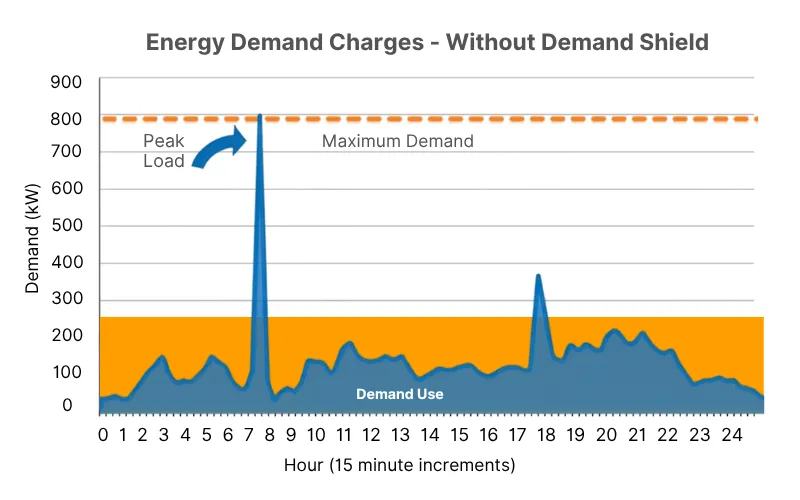
PG&E's demand charge is measured from the single highest 15-minute power draw in your billing period. Under the B-19 rate schedule, that charge is approximately $28-$38 per kilowatt — every month,
For cold storage facilities, when refrigeration compressors draw 40–60% above steady-state during startup, multiple defrost cycles can run simultaneously. These events create demand spikes you cannot prevent through operational discipline alone — but can levelize and reduce the demand spike and demand charge with the right system. That's where we can help.
The math on a typical facility during summer rates could be: A 800 kW peak at $28/kW = $22,400 demand charge that month — for a single number set by 15 minutes.
• Bay Area & North Bay • Greater Sacramento & Sacramento Valley • San Joaquin Valley • North Central Coast
• Bay Area & North Bay
• Greater Sacramento & Sacramento Valley
• San Joaquin Valley • North Central Coast
The DEMAND SHIELD SOLUTION
Three Integrated Layers - Working As One
Three Integrated Layers — Working As One
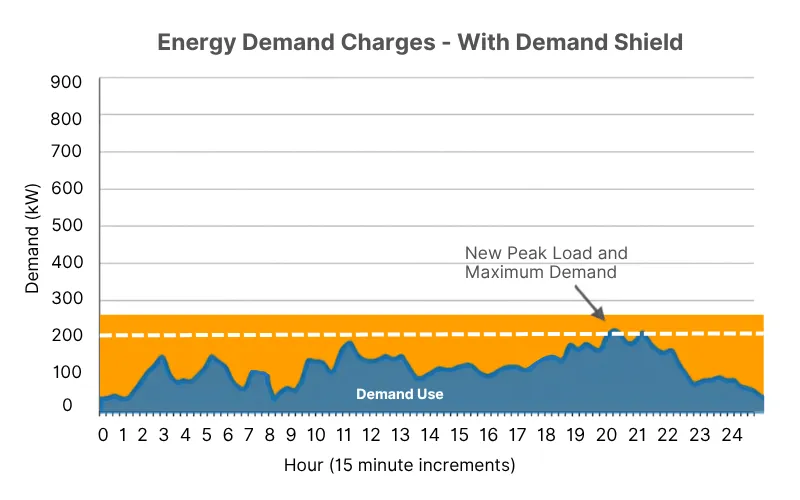
Most installers spec solar, battery, and software from separate vendors who've never met. VoltBlock designs and engineers all three as a single coordinated system in house. Our goal is to ensure that your demand requirements are flattened and fulfilled with the right sized battery energy storage system, your energy consumption is offset with the right sized solar system, all managed with the battery management system. We aim to shield your business from those 15-minute demand peaks and what PG&E charges you for the demand, saving your business hundreds of thousands, if not millions of dollars once deployed.
DEMAND SHIELD - LAYER 1
BATTERY ENERGY STORAGE SYSTEM
Incredibly safe, modular, sodium-ion batteries placed near your highest-demand load panels. No centralized battery room. Full performance at sub zero, cold storage ambient temperatures.
→ 25-year projected lifespan matched to
your solar asset
DEMAND SHIELD - LAYER 2
SOLAR GENERATION
Sized just right for your facility — not the maximum your roof can hold based off of 12 months of interval data to cover daytime consumption and charge the battery.
→ Roof structural assessment included
in scope
DEMAND SHIELD - LAYER 3
BATTERY MANAGEMENT SYSTEM
The BMS watches real-time grid draw, knows your PG&E rate schedule, and actively dispatches BESS to keep demand below your target threshold — every billing cycle.
→ Ongoing dispatch tuning as your
operations and rates evolve
Safe, reliable, smart and efficient battery technology
Sodium-ion batteries are exceptionally safe, perform reliably in extreme temperatures, and can discharge deeply and rapidly without wearing out. They're built to last more than 10,000 full charge-discharge cycles with no reduction in performance over time.
Our battery systems are installed in pods positioned around your facility. In many cases we pair them with Variable Frequency Drives — VFDs — which are controllers that adjust how hard your motors, pumps, fans, and compressors work at any given moment. Instead of running at full power all the time, a VFD dials the motor speed and torque to exactly what's needed. This lowers your facility's baseline electrical draw, which makes it much easier for our battery pods to handle the remaining demand spikes. If your facility already uses VFDs, we can often integrate our battery pods directly with your existing system.
Every facility operates differently, so we conduct a full analysis before recommending a system size. This often means placing monitoring equipment on your highest-demand equipment and taking real-time demand readings over several days — going beyond what your utility's data alone can show. This process also reveals whether your incoming three-phase power is balanced, because unbalanced power causes excess heat, vibration, and premature motor wear.
Ready to stop paying for 15 minutes?
Submit your PG&E interval data for a free, precise Demand Shield analysis
We'll build a model from your actual load data and show you exactly what Demand Shield saves you - before you commit a dollar.
VoltBlock Infrastructure
Demand Shield Systems for Cold Storage, Food Distribution & Industrial Facilities — Northern California
SERVICES
PAGES
© 2026 VoltBlock Infrastructure. All rights reserved. CSLB License #115524 • KG Electric • C10 Electric